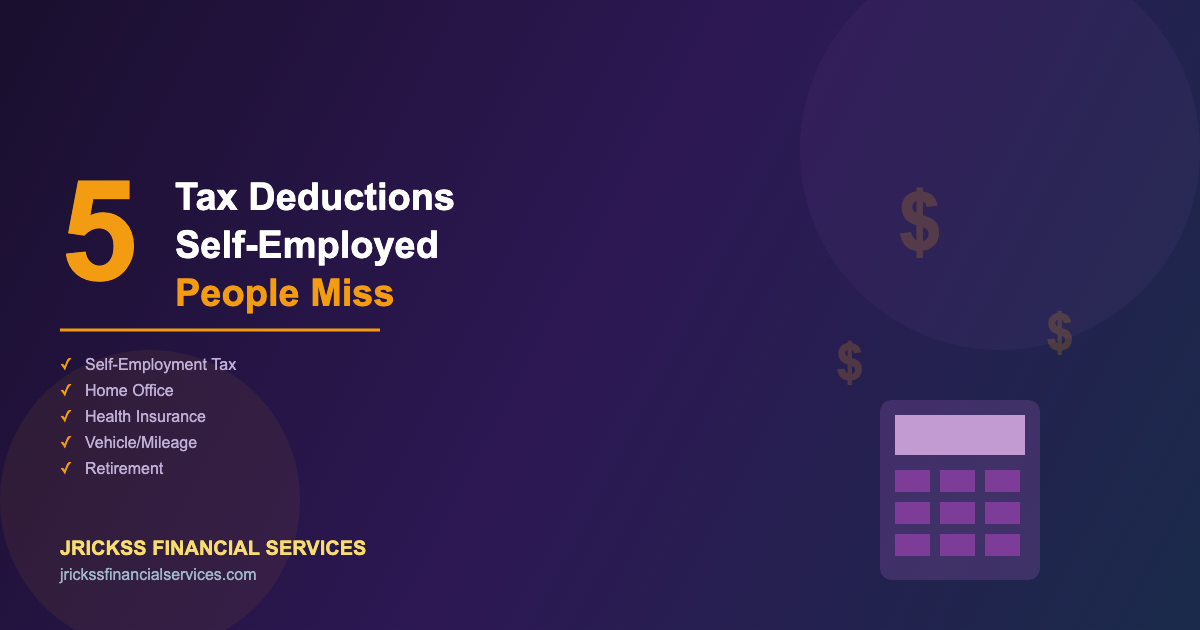
If you work for yourself — whether you run a business, freelance, drive for Uber or DoorDash, or do contract work — you are leaving money on the table if you don’t know about these deductions. Self-employed people pay more taxes than traditional employees because they cover both the employer and employee portions of Social Security and Medicare taxes. But the tax code also gives self-employed workers some powerful deductions to offset that burden.
Here are 5 tax deductions that self-employed people miss every year — and how to claim them for 2026.
When you work for yourself, you pay the full 15.3% self-employment tax (12.4% for Social Security + 2.9% for Medicare). Employees only pay half — their employer covers the rest. But here’s what most people miss: the IRS lets you deduct the employer-equivalent portion (7.65%) of your self-employment tax from your gross income. This is an “above-the-line” deduction, meaning you get it even if you don’t itemize.
This deduction is calculated on Schedule SE and then transferred to Schedule 1 of your Form 1040. If your net self-employment income is $80,000, that’s roughly $6,120 you can deduct right off the top.
If you use part of your home regularly and exclusively for business, you can deduct a portion of your housing expenses. The IRS offers two methods:
The key requirement is “regular and exclusive use.” Your home office can’t double as a guest bedroom. It has to be a dedicated workspace. Many self-employed people skip this deduction because they think it triggers audits — that’s a myth. Just make sure you qualify and keep records.
Self-employed people who pay for their own health insurance can deduct 100% of the premiums for themselves, their spouse, and their dependents. This includes medical, dental, and qualifying long-term care insurance. This is another above-the-line deduction — you don’t need to itemize to claim it.
The catch: you can’t claim this deduction if you were eligible for employer-sponsored health insurance through a spouse’s job or another employer during any month of the year. You can only deduct premiums for the months you were not eligible for other coverage.
If you use your car for business — meeting clients, driving to job sites, picking up supplies, or any work-related travel — you can deduct vehicle expenses. You have two options:
The most important thing: keep a mileage log. Write down the date, destination, purpose of the trip, and miles driven. Without documentation, you lose this deduction in an audit. Use a mileage tracking app to make it easy.
Note: commuting from home to a regular office does NOT count as business mileage. But if your home is your principal place of business, trips from home to client locations do count.
This is the deduction most self-employed people completely overlook. If you don’t have a retirement plan set up for your business, you’re missing one of the biggest tax shelters available.
These contributions are fully tax-deductible. If you make $100,000 in net self-employment income and contribute $25,000 to a SEP IRA, your taxable income drops to $75,000. That’s real money saved on your tax bill while building your retirement.
Self-employed taxes are complicated, but they don’t have to be stressful. A good tax professional will find deductions you didn’t know existed and make sure you’re paying the IRS only what you owe — not a dollar more.
JRICKSS Financial Services specializes in helping self-employed workers, freelancers, and small business owners in New Jersey file their taxes and maximize their deductions. Book a free consultation at jrickssfinancialservices.com/book or call us today.
